Investing · · 4 min
Time Value of Money
Archived article from 25 October 2021. Prices, results and products change, so check the current details before you buy or trade.
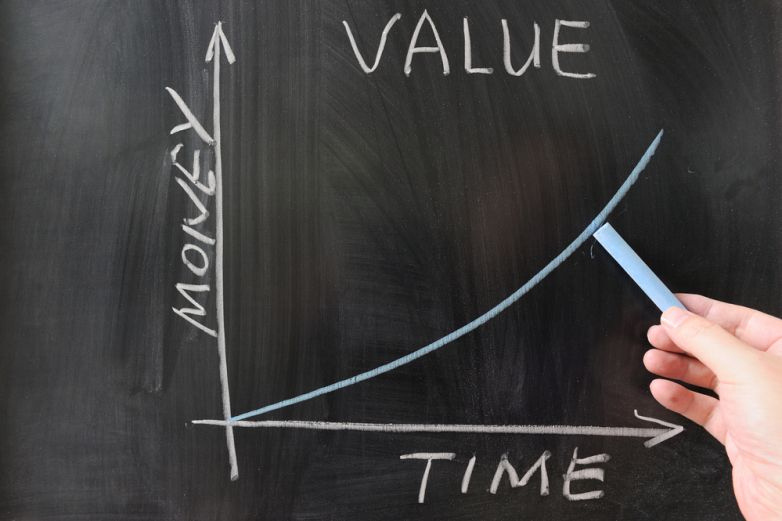
Time Value of Money (TVM) is an economic concept based on the view that the currently available cash is more valuable than an equivalent amount of that money in the future because of the earning potential of money over time.
This basic financial theory states that as long as money can earn interest, the earlier it is received, the more valuable it becomes. It is one of the essential ideas in finance to understand that money has a time value associated with it.
How the concept works
To illustrate the concept of TVM, consider an instance where you perform some construction work for a client, and he gives you an option of either paying you $20,000 now or $22,000 after 12 months. Accepting late payment would result in a guaranteed 10% more money.
Which payment method is best for you? There's no straight answer to it, but rather it's based on the current investment return you may expect to make on your money. For those who believe they can achieve more than a 10 percent return on their money by investing the $20,000 over the next year, they should not take the money.
It is better to accept the future payment of $22,000 if you don't think you can earn more than that amount over the next year if you invested it. This is provided you have faith in the person to pay you.
The role of purchasing power
Inflation, purchasing power, and TVM are all intertwined. Both of these aspects, as well as the potential return on investment, must be taken into account.
What's the significance of this? The value of money is constantly being eroded by inflation, which reduces the purchasing power of currencies. Commodity prices, such as are good examples. Twenty years ago, you could buy more loaves of bread for $100 than you can do today.
When investing, always ensure that you incorporate the effect of inflation on the purchasing power. This is because your net returns over time are a factor of the difference between the rate of inflation and the earnings you get as interest. As long as inflation exceeds your investment return, you will lose purchasing power, even if your investment earns you some money. For instance, even if your investment yields a 20% return, but inflation is running at 25 percent per year, your purchasing power is eroding by 5 percent per year.
The formula for calculating TVM
Individuals and businesses alike need to understand the TVM when making financial decisions. TVM is a particularly important consideration for companies when they want to venture into new market segments or acquire new companies or products.
The following five variables are the core components of TVM:
- Present value (PV): This is the money you have right now as your starting point. You might think of it as the cash in hand to be used as initial investment capital.
- Future Value (FV): It's the amount you'll have left at the end of the investment period. Considering that it should earn interest as it grows during the investment period, it should be worth more than PV.
- Number of periods (N): This refers to the length of time during which your money will be invested or during which you will hold on to the debt. In most cases, it is expressed as a number of years, but it can be on any time scale from weekly, monthly, quarterly or daily.
- Interest rate (I): It is the rate at which your investment will grow over the investment period. It is expressed as a percentage.
- Amount of payment (PMT): This is a succession of equal cash flows that are uniformly spaced out over predefined periods.
Future Value (FV)
With the formula below, the future worth of money can be calculated and compared to the current value:
FV=PV (1+i)n
Assuming you have $10,000, expect to receive 10% interest per year over the next five years. Here’s an example to illustrate how it works using the equation above. If the rate is compounded only once a year, the future value of your $10,000 is calculated as follows:
FV = $10,000 x (1 + 10% / 1) (1 x 5) = $16,105.10
Present Value (PV)
PV of money works out as follows: PV=FV/ (1+i) n
Using the method, you may work out how much money you'll get in the future, expressed as an equivalent amount presently. In this case, we get the PV by dividing the future value. This is useful for comparing two different amounts, one current, and the other future.
Our earlier example compared the costs of receiving $20,000 today versus receiving $22,000 in a year. Below is the method you'd use to determine if you could make 10% on your money now and wanted to determine the corresponding future value of that investment:
PV = $22,000 / (1 + (10% / 1) ^ (1 x 1) = $20,000
According to the calculations, for you to make a sound financial decision, you would need to be paid $20,000 now in order to ensure that your decision to forego the option of receiving $22,000 in the next year does not lead to a loss. In this case, $20,000 being paid now is fair compensation.
In summary
Any person participating in the financial decision-making process, such as capital budgeting and valuation, should understand the basic concepts behind TVM. It will help you safeguard your current and future investment from potential depreciation due to the changes in economic conditions over time.
Don't miss: The Best Forex Robots in 2021