Market outlooks · · 2 min
USDCAD Forecast Ahead of Canada Inflation Data

Archived article from 19 January 2022. Prices, results and products change, so check the current details before you buy or trade.
The USDCAD price is hovering near its lowest level since November 2021, ahead of the latest Canadian consumer inflation data. It is trading at 1.2500, which is about 3.50% below its highest level in December.
Canada economic data
The Canadian economy has made a strong comeback even though the current Covid-19 situation is a thorn in the flesh.
Data published earlier this month showed that the manufacturing PMI did modestly well in December last year.
Additional data revealed that the country’s unemployment rate tilted downward to 5.9% in December after it added over 55k jobs.
The next key catalyst for the USDCAD pair will be the Canadian consumer inflation data that will come out on Wednesday.
Data compiled by Investing.com is expected to show that the Canadian headline CPI fell from 0.2% in November to -0.1% in December. On a year-on-year basis, analysts expect the data to reveal that inflation rose from 4.7% to 4.8%. The Bank of Canada (BOC) has an inflation target of about 2.0%.
The core CPI number is also expected to drop modestly from about 0.6% in November to 0.1% in December. On a YoY basis, the country’s core inflation is expected to have dropped to about 3.5%.
If analysts are correct, these numbers mean that the country’s inflation is starting to reach its peak level. Recent data from other countries like the United States and China have shown that inflation growth has slowed.
Crude oil prices
Canada is a leading crude oil producer. Therefore, the Canadian dollar tends to do well in a period when the prices of crude oil are rising.
This year alone, oil prices have surged as investors anticipate more demand going forward. For example, Brent, the international benchmark, is trading at a seven-year high of over $87. WTI, the American benchmark, is trading at $85, which is a strong number considering that it fell to the negative zone in 2020.
Oil prices have risen because analysts expect that demand will keep rising this year as the world economy rebounds. At the same time, supply is expected to remain under pressure because of slow investment growth by oil companies. The rising oil prices explain why the USDCAD pair has been in a bearish trend.
US bond yields
The USDCAD price also declined even as the US dollar gained against most currencies. The dollar index has jumped by over 3% from its lowest level last week as investors worry about the ongoing bond sell-off.
On Tuesday, the bond sell-off helped to push the 10-year Treasury yield to a two-year high of almost 2%. The 30-year bond yields jumped to the highest level since July last year.
The performance of the bond market is mostly because analysts expect that the Federal Reserve will be more aggressive going forward. It has hinted that it will start hiking interest rates in the coming months.
USDCAD forecast
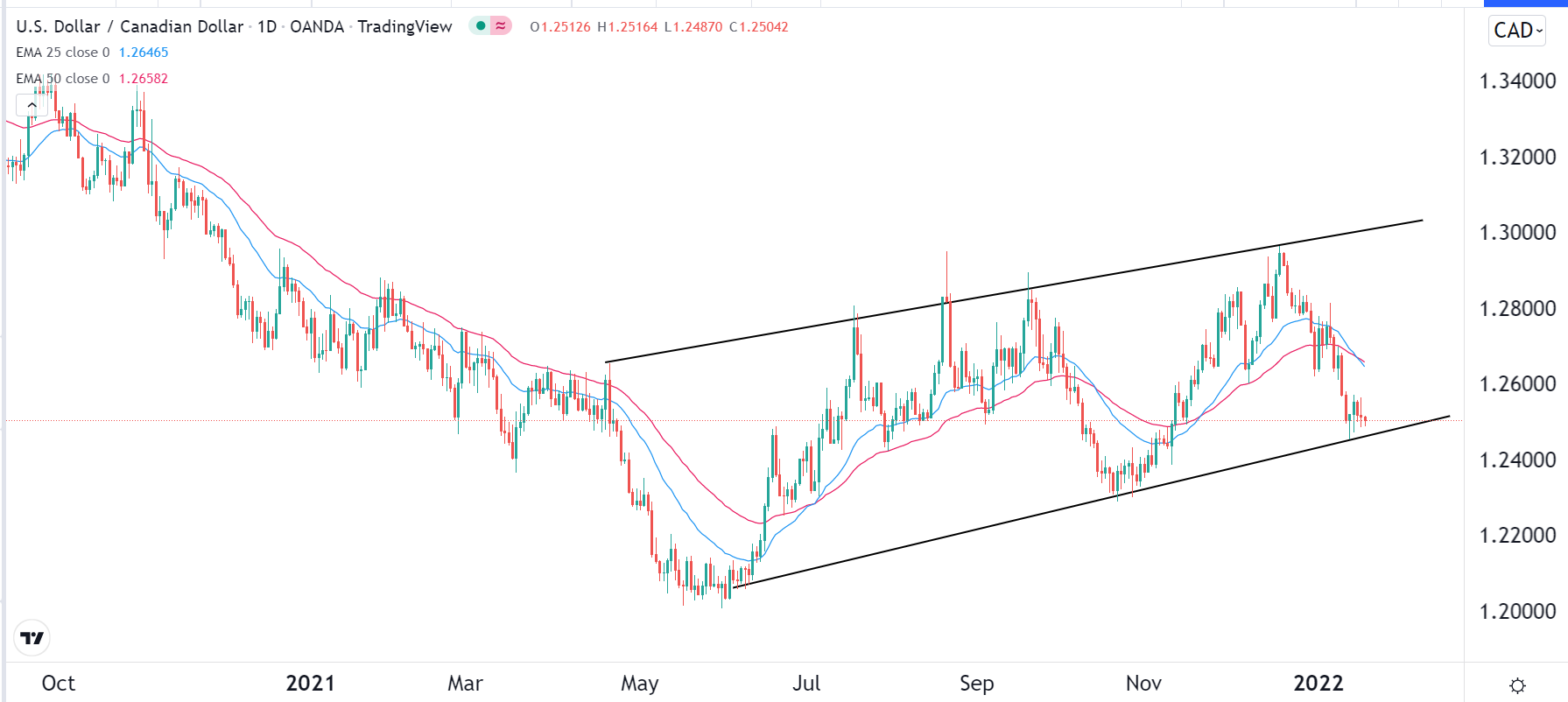
The daily chart shows that the USDCAD pair has been in a strong bearish trend in the past few weeks. Along the way, the pair formed an ascending channel pattern that is shown in black. The price is slightly above the lower side of this channel.
It has managed to move below the 25-day and 50-day moving averages. The two averages have even made a bearish crossover. Therefore, the pair will likely have a bearish breakout in the near term.
Don't miss: The Best Forex Robots in 2021