Crypto trading · · 4 min
AR vs. VR NFTs: The Future of Non-fungible Tokens

Archived article from 21 April 2022. Prices, results and products change, so check the current details before you buy or trade.
Metaverse is an important concept that is set to change how the world operates in the virtual space. In fact, in 2021, Facebook decided to change its business name to Meta Platforms in a bid to take advantage of this growing industry.
A recent study estimated that the global metaverse industry will rise to over $786 billion by 2030. In this article, we will take a look at the key building blocks of the metaverse: augmented reality (AR) and virtual reality (VR), and their future in the industry.
What is Augmented Reality?
According to Gartner, Augmented Reality is a technology that happens in the form of text, graphics, and audio enhancements. It is then integrated with real-world objects. The idea of integrating it with the real-world environment is important in that it helps to distinguish it from other forms of technologies like virtual reality. A good example of AR is Pokemon Go, the mobile game that lets people interact with the real world.
What is virtual reality?
Virtual reality is a technology that lets developers create a whole new universe that is mostly aspirational. The main difference between VR and AR is that virtual reality does not seek to integrate with the real-world universe. In most cases, people interact with virtual reality with devices like Facebook’s Oculus, Samsung’s Galaxy Gear, and Lenovo’s Mirage.
How metaverse fits in
AR and VR are two important parts of the ongoing fast-growing industry known as the metaverse. The idea is that developers can create digital platforms that combine concepts of artificial intelligence and virtual reality.
A good example of its application is in the gaming industry, where developers can build games that include the two concepts. Indeed, people have been using tools offered by companies like Roblox for many years.
Another example is where developers can create virtual platforms where people can do real business and arrange events.
Non-Fungible Tokens (NFT)
There are several factors that have made the metaverse industry grow. First, there is the issue of smart contracts, which is a self-executing programs that are written in code. They work in a similar process to normal physical contracts.
Second, there are NFTs, which have become popular in the blockchain industry. NFTs allow people to buy and own unique items on the internet. A certain smart contract secures each NFT.
VR and AR help designers build a diverse universe that is commonly known as the metaverse. At the same time, there are NFTs that power commerce in this ecosystem.
How can VR and AR be used in NFTs?
There are several industries in that VR and AR can be used well. Some of the most popular use-cases for this technology are listed below.
Gaming
Gaming is a leading field that is valued at billions of dollars. For a long time, the industry was dominated by the likes of Nintendo, Microsoft, Sony, Take-Two Interactive, Activision Blizzard, and Tencent. These are all multi-billion dollar companies that are highly centralized.
Gaming companies make money in a number of ways. Some of them earn by selling their games at an outright price, while others specialize in micro-transactions. A good example of this is Fortnite, which sells items worth billions of dollars every year.
As a result, gaming companies are not loved by their players. For example, for years, EA Sports has been one of the most hated companies in the world. Other game developers like Activision Blizzard are not loved either.
This hate tends to come from how these games monetize their users. EA Sports has been criticized for unilaterally increasing prices in a bid to boost its stock price.
Therefore, developers have come up with decentralized gaming platforms that take advantage of virtual reality, augmented reality, and non-fungible tokens (NFT). These games are owned by the community, which must vote for all decisions that happen. This means that a developer cannot raise prices whenever they feel like it.
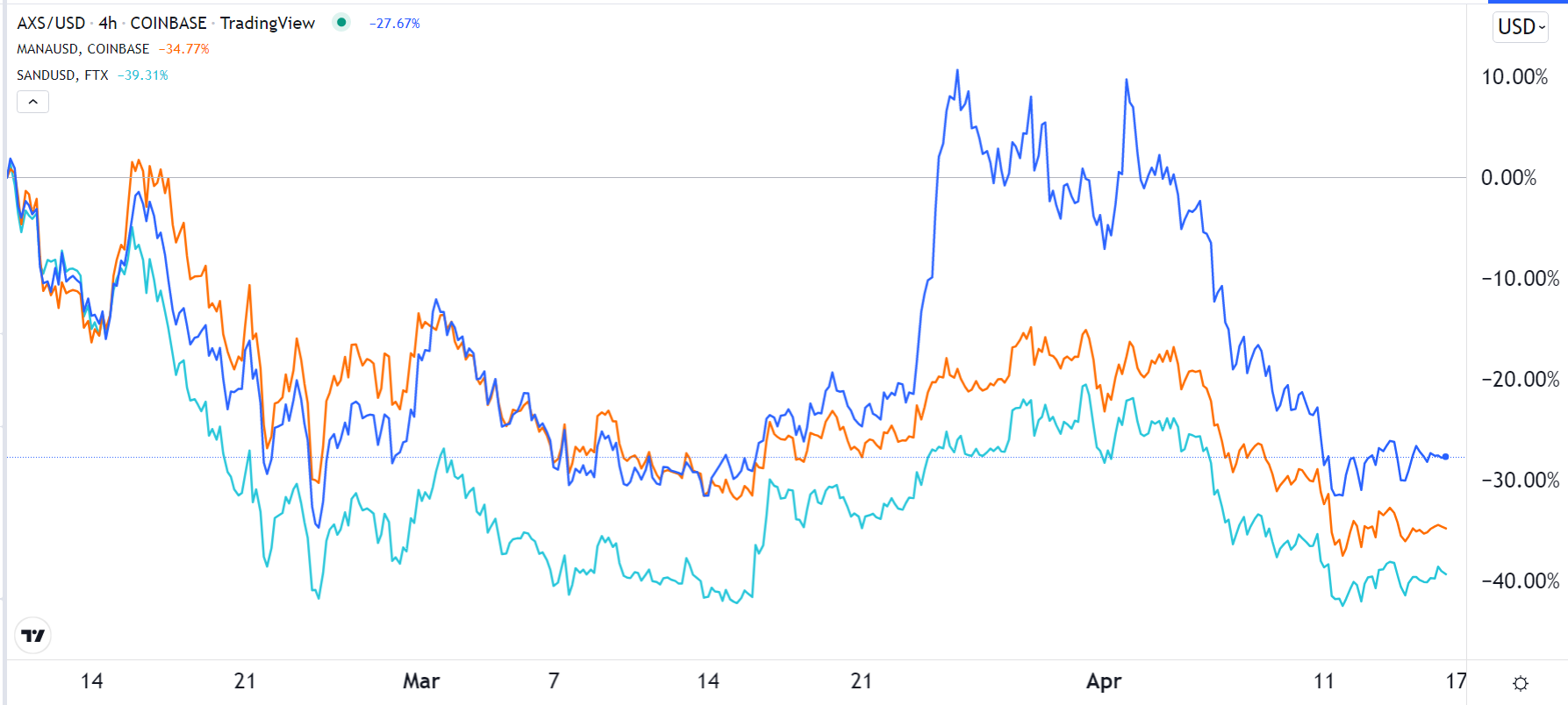
Most importantly, these decentralized gaming platforms don’t take all the profits. Instead, the income is distributed to holders of their respective tokens. Examples of gaming blockchains are Axie Infinity, Sandbox, Decentraland, MOBOX, and Decentral Games. The chart above shows the performance of the SAND, AXS, and MANA tokens.
E-commerce
Another industry that is seeking to use VR, AR, and NFTs is e-commerce. For a long time, e-commerce has operated in a simple way. People visit a website and buy items, and then they are shipped to them.
Analysts believe that there is room for incorporating the three concepts to make it in the e-commerce industry. Indeed, in the past few months, the number of established brands that are moving to the metaverse has been increasing.
In the first quarter of 2022, Decentraland hosted the first metaverse fashion week that saw leading brands like Dolce & Gabanna, Imitation of Christ, and Etro participate. While the industry is in its early days, it will likely grow in popularity in the coming years. It will ensure that people have a better shopping experience when buying online.
Art
For years, the world of fine art has been dominated by a small group of companies like Christie's, Sotheby’s, and Philips. The metaverse is changing this by allowing artists to sell their arts in the form of NFTs on the internet. Indeed, popular NFT platforms like Bored Ape Yacht Club and Azeka have grossed billions of dollars. It is also possible to buy unique art avatars on popular platforms like Decentraland and Sandbox.
Summary
Virtual reality, Augmented reality, and the metaverse is two concepts that are growing in popularity these days. In this article, we have looked at how the industry works and some of the most important industries that it could disrupt in the coming years.
Don't miss: The Best Forex Robots in 2021