Crypto trading · · 5 min
What Are Bitcoin Price Gaps: Your Guide to Trading the Gap in the Cryptocurrency Market

Archived article from 30 November 2021. Prices, results and products change, so check the current details before you buy or trade.
A large jump in asset prices is a common occurrence in volatile markets. Cryptocurrencies, some of the most volatile assets, are known to experience sharp price movements, which often results in gaps in areas of the chart. These areas of little or no market activity in the chart provide unique trading opportunities.
What Bitcoin price gaps mean
A bitcoin price gap is essentially an area in the chart whereby the price rises or falls from the previous close without trading activity occurring. A big gap either up or down in the chart shows a sharp increase in momentum in a given direction.

When Bitcoin price gaps upwards, it means zero traders were willing to sell at these levels, thus triggering a sharp price move to the upside. Likewise, if the price was to gap lower, it means there were zero buyers to counter the short-sellers, thus resulting in the sharp movement.
What causes Bitcoin gaps: CME vs. crypto exchanges
While Cryptocurrencies trade 24 hours a day, seven days a week, price gaps are a rare occurrence on crypto exchanges. However, the introduction of BTC futures contracts on the Chicago Mercantile Exchange has triggered regular gaps after the weekends and holidays.
On the CME, trading activity takes place five days a week, excluding the weekends and holidays. Consequently, whenever the CME market opens after the weekend or a holiday, a price gap on BTC futures charts is common due to the trading activity that took place in crypto exchanges while it was closed.
Traders are increasingly building trading strategies around the BTC gaps that come into play when the CME markets open after the weekend or a holiday. Traders place positions accordingly if a fluctuation over the weekend resulting in a gap is deemed too optimistic or pessimistic.
Bitcoin futures are becoming increasingly popular because they allow people to gain exposure without holding the underlying cryptocurrency. In this case, traders take cash instead of physical delivery of the digital currency upon settling a contract.
In addition, BTC futures contracts allow traders to trade in micro-lots. In this case, one can buy or sell a minimum contract of 0.1BTC. In contrast, in crypto exchanges, the minimum trade that one can take is only $10
Types of Bitcoin gaps
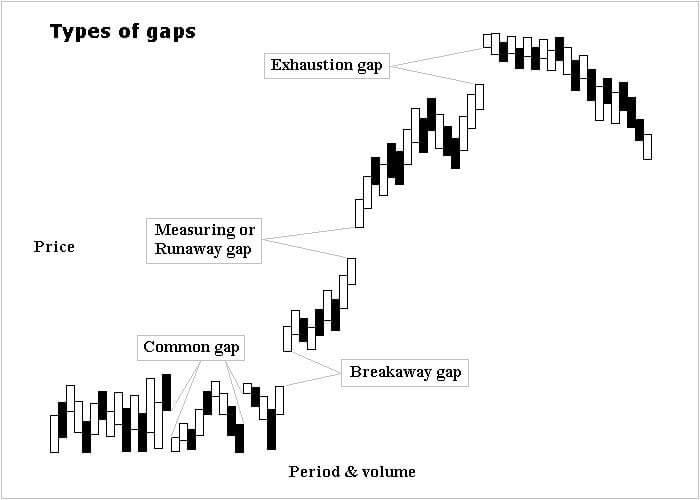
Breakaway gaps: Occur after a period of consolidation whereby BTC price edges higher or lower as if to confirm the strength of a new trend.
Exhaustion gap: Occurs after the price has moved significantly in a given direction until exhaustion kicks in. The gap comes into play to confirm the end of the underlying trend as price hits a final new high or low.
Common gaps: there is usually no reason as to why BTC gapped. In most cases, the price often retreats only to fill the gap.
Continuation gaps: Occurs in the middle of a trend to show the momentum is building up and that the price is likely to continue moving up or down depending on the underlying trend.
Trading Bitcoin gaps
While BTC gaps underscore price momentum in a given direction, many at times get filled. Therefore, it is common to find traders trading in the opposite direction of the gaps to squeeze in a profit as price retrace to fill the gaps.
However, it is important to note that the filling process can take hours, days, or even weeks, depending on the underlying market momentum.
The chart below clearly shows how BTC gaps came into play only for the market to retrace and fill after some time.

Gaps get filled if the price spike up or down was too optimistic or pessimistic. In most cases, correction often kicks in, resulting in price retracing to try and correct the error. In addition, if the action was quite sharp, the prospects of finding traders to buy high or sell low are usually low.
Consequently, the Bitcoin price will retrace to fill the gap. The filling action results in a favorable rate that often attracts traders who missed out on the initial run either up or down.
While trying to profit from gaps, it is important to ensure that trades are placed in the overall direction of the price. Focus, in this case, should be on the higher time frame, at least 4 hours, whereby the trade is to be opened.
Additionally, the Bitcoin price should retrace to the initial resistance or support level, fill the gap, and bounce back in the continuation of the underlying trend.
Not to fill
In addition to placing trades in the opposite direction in a bid to try and profit as the BTC gap fills, it is also important to note that gaps can take quite some time to fill. When fundamentals or technicals are strong enough, the prospect of BTC price retracing to fill the gap is usually low.
Consequently, it is common for traders to open trades above or below the gap to try and ride the momentum in the direction of the gap. The position short or long will be left open until the price hits support and resistance level. Rejection at the support and resistance level would be an early sign to exit as the price would often retrace and come back to fill the gap.
Things to remember
When Bitcoin or any other cryptocurrency starts to fill the gap, it will rarely pause or stop midway. The gap will often end up being filled given the lack of support of resistance midway.
While trading BTC gaps, it is important to classify them properly. For starters, exhaustion gaps will often result in price starting to move in the opposite direction of the gaps. Such gaps come with low volume as if to indicate momentum is waning.
Continuation gaps, on the other hand, affirm strong momentum in the direction of the gap. In this case, the price will continue moving up or down without trying to fill the gap. Such gaps come supported with high volume affirming the strength of the momentum.
Bottom line
Bitcoin gaps occur when the price opens higher or lower from the previous close indicating little or no activity at a given level. While most of them get filled within a week, it is common to find gaps remaining open for even months, depending on the strength of the momentum in the direction of the gap.
Don't miss: The Best Forex Robots in 2021